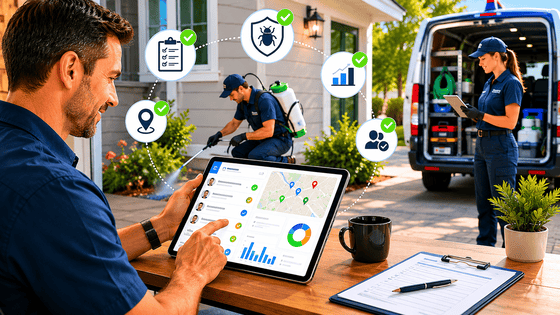
Why Pest Control CRMs Fail Without Job Data
Pest control CRM systems fail without job data. Discover why integrated job tracking and customer management software is essential for pest control business.
Why CRM Alone Isn’t Enough for Pest Control Businesses
Running a pest control business is not just about managing customers. It is about managing jobs, technicians, compliance requirements, chemical usage, service history, and recurring schedules. Yet many pest control businesses invest in a pest control CRM expecting it to solve everything, only to discover it creates more gaps than it fills.
On paper, a CRM sounds perfect. It stores customer details, tracks communication, and helps manage relationships. But pest control is a field service industry. Without job data, your CRM becomes little more than a digital address book.
If your team is still switching between spreadsheets, paper job sheets, and disconnected apps, you are seeing the limitations firsthand. Customer management alone does not run operations. Job tracking does.
The Problem with CRM-Only Systems in Pest Control
Most CRMs are built for sales teams, not field technicians. They focus on pipelines, leads, and contacts. Pest control businesses need something very different.
A typical day involves:
- Scheduling technicians across multiple locations.
- Recording treatment details and chemicals used.
- Capturing photos and site notes.
- Generating service reports.
- Managing recurring service agreements.
- Handling compliance documentation.
- Tracking follow-ups and re-treatments.
A standard CRM does not handle these workflows. It stores the customer, but not the job.
This creates operational blind spots. Your office knows who the customer is, but not what happened on-site. Your technicians complete work, but the CRM never records the details. Your compliance records live somewhere else entirely.
Over time, the system breaks down.
Why Job Data Is Critical for Pest Control Businesses
Job data is the operational backbone of pest control. Without it, you cannot accurately track what services were delivered, when they were completed, or what treatments were applied.
Job data includes:
- Service type and treatment performed;
- Technician notes and findings;
- Chemical usage and quantities;
- Site conditions and risk areas;
- Photos and evidence;
- Customer signatures;
- Follow-up requirements;
- Compliance documentation; and
- Time on site and travel tracking.
This information is essential for both operational efficiency and regulatory compliance. A pest control CRM with integrated job data fosters confidence in your decision-making, ensuring you trust your data for business growth.
For example, when a customer calls about recurring ants, your team needs to see:
- What treatment was applied last time?
- Which technician attended?
- What areas were treated?
- What chemicals were used?
- Was a follow-up recommended?
Without job tracking, your team has to guess. That leads to repeat visits, wasted chemicals, and frustrated customers.
The Real-World Consequences of Disconnected Systems
Many pest control businesses try to patch the gap by using multiple tools:
- CRM for customer details;
- Spreadsheet for scheduling;
- Paper forms for job sheets;
- Email for reports; and
- Cloud storage for photos.
This fragmented workflow causes problems quickly.
Technicians forget paperwork. Office staff re-enter data manually. Reports are delayed. Compliance records get lost. Customers call asking for service history, and nobody can find it.
The bigger your business grows, the more critical it becomes to have a scalable, integrated system that manages increasing job data seamlessly, preventing operational breakdowns and supporting expansion.
Disconnected systems also create risk. Pest control operations often require detailed documentation for audits, insurance, and regulatory bodies. If your job data is scattered, maintaining compliance becomes difficult.
Why Integrated Software Changes Everything
The solution is not just a better CRM. It is an integrated software that connects customer management with job tracking.
When job data is built into your system:
- Customer records update automatically after each job.
- Technicians capture data in the field.
- Reports generate instantly.
- Compliance records are stored centrally.
- Recurring services are scheduled automatically.
- Office staff see real-time job progress.
Instead of managing contacts, your CRM becomes an operational hub.
This is where purpose-built pest control platforms make a difference. Rather than forcing your workflow into a generic CRM, integrated systems are designed for field service operations.
What an Integrated Pest Control CRM Should Include
To truly support pest control businesses, your system should combine customer management with operational job tracking.
Look for features such as:
Job Scheduling and Dispatch
Assign technicians, manage routes, and track job status in real time. This removes confusion and reduces missed appointments.
Digital Service Forms
Technicians complete treatment reports onsite using mobile devices: no paper, no retyping, no delays.
Chemical Usage Tracking
Record products used, quantities applied, and treatment areas. This supports compliance and improves inventory control.
Customer Service History
Every job automatically updates the customer profile. Your team always knows what happened last time.
Photo and Signature Capture
Attach images and customer approvals directly to the job record.
Automated Reporting
Generate branded service reports immediately after job completion.
Recurring Service Management
Schedule monthly, quarterly, or annual services without manual tracking.
These capabilities transform a basic pest control CRM into a true operational platform.
How This Improves Productivity
When job data flows directly into your CRM, your team spends less time chasing information and more time delivering services.
Technicians no longer:
- Fill out paperwork.
- Call the office for job details.
- Return to submit reports.
- Duplicate information.
Office staff no longer:
- Re-enter handwritten notes.
- Search for missing forms.
- Email reports manually.
- Track recurring jobs manually.
Everything connects. Everything updates automatically.
The result is faster workflows, fewer mistakes, and better customer experiences.
Compliance Becomes Easier, Not Harder
Pest control businesses operate under strict documentation requirements. Missing records can create liability issues and audit risks.
Integrated job tracking ensures:
- Treatment records are complete.
- Chemical usage is documented.
- Service dates are recorded.
- Technician notes are stored.
- Customer approvals are captured.
Instead of scrambling during audits, your records are already organised.
This is one of the biggest advantages of combining job tracking with customer management in one system.
Better Data Leads to Better Business Decisions
When your CRM includes job data, you gain operational insights such as:
- Most common pest issues;
- Technician productivity;
- Repeat service frequency;
- High-value customers;
- Chemical usage trends; and
- Service time averages.
This information helps you improve scheduling, pricing, and staffing decisions.
Without job data, your CRM cannot provide these insights.
CRM Alone Manages Contacts, Integrated Software Runs Your Business
A standalone CRM helps you store customer details. That is useful, but not enough for pest control operations.
What you really need is:
- Customer management;
- Job tracking;
- Compliance documentation;
- Technician workflows;
- Automated reporting; and
- Recurring service scheduling.
When these elements are connected, your system becomes the operational backbone of your business.
That is the difference between managing customers and managing work.
The Bottom Line
A pest control CRM without job data cannot support real-world field operations. It creates gaps between office staff and technicians, increases manual work, and makes compliance harder.
Integrated software solves this by combining customer management with job tracking, reporting, and operational workflows into a single platform. The result is better visibility, improved productivity, and a more scalable business.
If your CRM feels incomplete, the missing piece is job data.
Start Running Your Pest Control Business on One Connected System
Stop juggling disconnected tools and start managing customers, jobs, and compliance in one place.
Start a Free Trial and see how integrated pest control software can transform your operations.