The Hidden Cost of Poor Job Notes
Weak job notes can lead to customer disputes, failed audits, and costly rework. Learn how better pest control reporting protects your business.
Why Weak Job Notes Lead to Disputes and Rework
In pest control, the job is not finished when the treatment is complete. It is finished when the documentation accurately tells the story of what happened on site.
That is where many businesses run into trouble.
A technician might perform excellent work, apply the correct treatment, and communicate professionally with the customer. But if the job notes are vague, incomplete, or inconsistent, the business is left exposed when questions arise later.
And those questions always come eventually.
Maybe a customer claims they were never advised about follow-up actions. Maybe a technician revisits a property without knowing what was treated previously. Maybe an audit uncovers missing chemical records. Or perhaps a dispute escalates because there is no clear evidence of what occurred during the visit.
Weak pest control reporting creates hidden operational costs that many businesses underestimate until the damage is already done.
The Real Cost of Poor Job Notes
Most pest control businesses view job notes as simple administrative tasks. In reality, they are operational protection.
When reporting standards slip, the effects spread quickly across the business.
Customer Disputes Become Harder to Defend
Disputes are part of running a service business. What matters is whether your records can support your team when issues arise.
Imagine this scenario:
A customer calls three weeks after a treatment and says the technician never inspected the roof void. The technician remembers doing it, but the notes only say:
“Completed inspection and treatment.”
That single sentence provides no protection.
There is no record of inspection zones, findings, recommendations, photos, customer discussions, or evidence of completed work.
Now compare that to detailed digital notes that include:
- Areas inspected;
- Pest activity identified;
- Treatment methods used;
- Chemical quantities applied;
- Photos before and after treatment;
- Customer recommendations; and
- Customer sign-off.
One version creates uncertainty. The other creates accountability and clarity.
Detailed job notes can often resolve disputes before they escalate because customers can clearly see what was done.
Rework Quietly Drains Profitability
One of the highest hidden costs of poor reporting is unnecessary rework.
When technicians return to sites without clear historical records, valuable time gets wasted trying to reconstruct previous visits.
Questions start piling up:
- Which areas were treated last time?
- Were bait stations replaced?
- What product was used?
- Was termite activity identified previously?
- Did the customer decline any recommendations?
Without reliable notes, technicians either spend extra time investigating or unnecessarily repeat work.
Neither option is profitable.
For growing pest control businesses managing multiple technicians and hundreds of recurring services, inconsistent reporting creates operational confusion that compounds over time.
Weak Documentation Creates Compliance Risks
Pest control is a compliance-heavy industry. Accurate records are not optional.
Depending on your location and service type, your business may need to maintain records relating to:
- Chemical usage;
- Safety procedures;
- Treatment methods;
- Risk assessments;
- Customer notifications;
- Site inspections; and
- Follow-up recommendations.
Incomplete or inconsistent pest control reporting can create serious issues during audits, insurance claims, or legal disputes.
Even highly skilled technicians can expose the business if reporting processes rely on memory, handwritten notes, or inconsistent templates.
This is especially risky for businesses handling commercial contracts, food facilities, schools, healthcare sites, or government work where reporting standards are higher.
Handwritten Notes Often Create More Problems Than They Solve
Many pest control businesses still rely on paper forms or free-text note fields.
At first glance, this feels simple. In reality, it introduces several problems:
- Notes become inconsistent between technicians.
- Important details get forgotten.
- Handwriting can be unclear.
- Photos are stored separately.
- Office staff waste time chasing missing information.
- Reports are difficult to retrieve later.
Paper systems also make it harder to standardise reporting quality across the business.
One technician may write detailed observations while another writes only a few words. Over time, that inconsistency affects the customer experience, operational visibility, and confidence in compliance.
Good Job Notes Improve Team Communication
Strong reporting does not just protect the business externally. It improves internal operations, too.
When technicians can quickly review accurate service history before arriving on-site, they make better decisions faster.
Instead of starting from scratch, they can see:
- Previous pest activity;
- Treatment outcomes;
- Site risks;
- Customer concerns;
- Recommendations provided; and
- Recurring problem areas.
This is particularly valuable for businesses with multiple field technicians or high staff turnover.
Good documentation keeps knowledge within the business rather than leaving it trapped in individual employees’ memories.
Customers Expect Professional Reporting
Modern customers expect more than a verbal summary at the end of a job.
Commercial clients especially want professional digital reports that clearly document:
- What was found?
- What was treated?
- What risks remain?
- What actions are recommended?
Detailed reporting demonstrates professionalism and transparency, helping your customers trust your expertise and services.
It also helps justify the value of the service being delivered.
A clear, photo-supported report reinforces the expertise behind the treatment, rather than making the job feel like a quick spray-and-go visit.
How Digital Reporting Solves the Problem
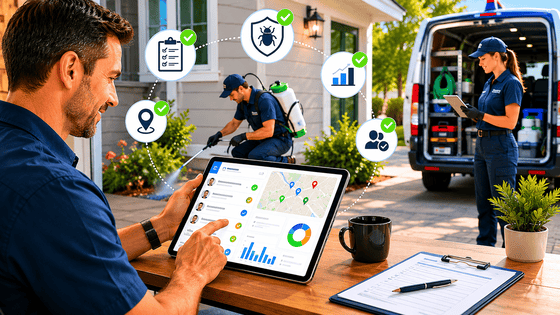
This is where digital field service platforms like Pest Management App help pest control businesses operate more efficiently by providing a smooth transition from paper to digital reporting, minimising disruption.
Using digital forms and mobile workflows allows businesses to:
Standardise Reporting Quality
Every technician following the same reporting process can feel more confident and supported, knowing they capture all critical details.
Attach Photos and Evidence
Photos provide visual proof of findings, treatments, and completed work, helping reduce disputes and improve transparency.
Capture Signatures Instantly
Digital customer sign-offs create clear confirmation that services and recommendations were acknowledged onsite.
Access Service History Anywhere
Technicians and office staff can instantly retrieve previous reports, treatment history, and customer records.
Improve Compliance Confidence
Structured digital records help your team feel more secure and confident during audits and regulatory checks by maintaining accurate, searchable documentation.
Reduce Admin Time
Automated reporting reduces double handling, paperwork delays, and manual data entry back at the office.
Better Notes Lead to Better Business Performance
Strong job notes are not just about compliance. They directly impact profitability, customer satisfaction, operational efficiency, and business reputation.
When reporting systems improve:
- Disputes become easier to resolve.
- Technicians work more efficiently.
- Rework decreases.
- Compliance risks are reduced.
- Customers gain confidence.
- Managers gain visibility into field operations.
The businesses that scale successfully are usually the ones with strong operational systems behind the scenes.
And good documentation is one of the most important systems of all.
Start Improving Your Reporting Process Today
Poor reporting rarely looks expensive at first.
It shows up slowly through wasted technician time, unresolved disputes, inconsistent service quality, frustrated office staff, and compliance stress.
But over time, those hidden costs add up quickly.
Improving your pest control reporting process is one of the simplest ways to protect your business while boosting operational efficiency and customer trust.
If your team is still relying on handwritten notes, inconsistent reporting habits, or disconnected systems, now is the time to modernise the process.
See how digital job notes, mobile reporting, and automated workflows can help your pest control business reduce disputes, improve compliance, and eliminate unnecessary rework.