The Admin vs Growth Trade-Off Pest Owners Face
Discover how admin burden limits business growth for pest control companies and how pest control software helps owners scale efficiently.
Why Admin Work Caps Business Growth
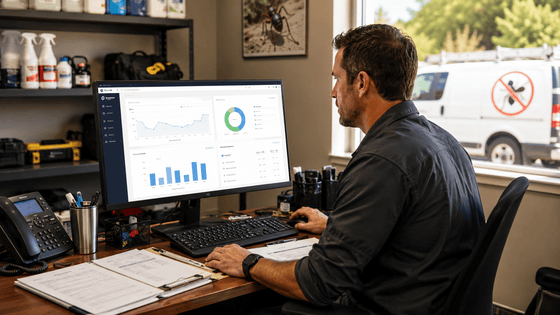
Running a pest control business is not just about solving pest problems. For many owners, the real challenge starts after the technician leaves the site.
Quotes need to be sent. Reports must be completed. Compliance records have to be stored correctly. Invoices need chasing. Schedules change constantly. Customer calls keep coming in.
At first, handling these tasks manually feels manageable. But as the business grows, the admin workload grows even faster.
This creates a common trade-off in the industry: spend time on admin or spend time growing the business.
Many pest control business owners end up trapped in the admin cycle, feeling overwhelmed and unable to focus on the bigger picture because daily paperwork keeps pulling them back in.
The Hidden Cost of Admin Burden
Most pest control operators underestimate how much time admin actually consumes.
A single job may involve:
- Customer communication;
- Site risk assessments;
- Technician scheduling;
- Compliance documentation;
- Chemical usage records;
- Service reports;
- Invoice creation;
- Payment follow-up; and
- Internal QA checks.
Multiply that across dozens or hundreds of jobs each week, and the hours disappear quickly.
The problem is not just time. It is an opportunity cost.
Every hour spent manually entering data or chasing paperwork is an hour not spent:
- Winning new contracts;
- Training technicians;
- Improving customer retention;
- Expanding service areas;
- Building recurring revenue; and
- Strengthening operational systems.
Many pest control businesses hit a growth ceiling not because demand is lacking, but because the owner becomes the bottleneck.
Why Growth Becomes Harder as the Business Expands
Growth sounds exciting until operational complexity increases.
A business with two technicians may survive with spreadsheets and paper forms. A business with ten technicians usually cannot.
As teams grow, common issues start appearing:
Scheduling Becomes Chaotic
Whiteboards, phone calls, and manual calendars quickly become unreliable.
Double bookings, missed appointments, and inefficient routes create frustration for both staff and customers.
Compliance Risks Increase
Pest control businesses operate in a highly regulated environment. Chemical handling records, treatment reports, and safety documentation must remain accurate and accessible.
When paperwork is scattered across folders, vehicles, and inboxes, compliance becomes difficult to manage confidently.
Invoicing Delays Hurt Cash Flow
Manual invoicing often gets pushed aside during busy periods.
A technician finishes the work, but the paperwork sits unfinished for days. The invoice is delayed, so payment is delayed too.
For growing businesses, this creates unnecessary cash flow pressure.
Owners Stay Stuck in Operations
Many business owners become permanent administrators instead of leaders.
Rather than focusing on strategy and growth, they spend evenings catching up on reports and weekends fixing scheduling issues.
Over time, burnout becomes a real risk.
The Real Growth Killer: Context Switching
One of the biggest, yet least discussed, productivity drains is constant context switching.
A pest control owner might spend a morning:
- Answering customer calls;
- Updating technician schedules;
- Checking overdue invoices;
- Sending compliance documents;
- Managing inventory; and
- Responding to technician questions.
Every interruption breaks focus.
Instead of making strategic decisions that move the business forward, owners remain trapped, reacting to operational problems all day long.
This reactive mode limits long-term business growth because there is no time left for proactive planning.
How Pest Control Software Changes the Equation
The most successful pest control companies are not necessarily working harder. They are removing friction from their operations.
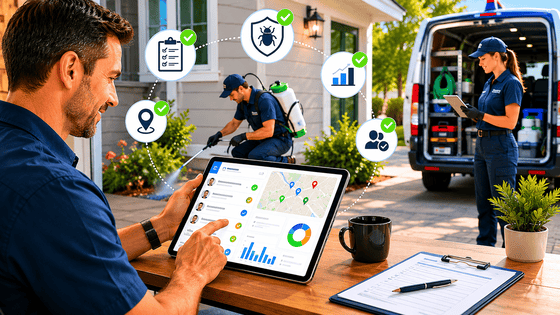
Modern pest control software helps owners see growth as attainable by removing friction from their operations, making scaling feel more manageable.
Instead of juggling disconnected systems, everything runs on a single central platform.
Key Areas Where Automation Saves Time
Digital Forms and Reports
Technicians can complete service reports directly from the field using mobile devices.
Photos, signatures, treatment details, and compliance records are captured instantly and stored automatically.
This removes duplicate data entry and reduces paperwork errors.
Automated Scheduling
Smart scheduling tools help dispatch technicians efficiently while reducing manual coordination.
Changes can be updated in real time, helping teams stay organised throughout the day.
Faster Invoicing
Invoices can be generated immediately after job completion.
This speeds up payment cycles and improves cash flow consistency.
Centralised Compliance Records
Compliance documentation stays organised and searchable in one system.
If a customer requests treatment records or regulators require documentation, information can be retrieved quickly without digging through paper files.
Better Visibility Across Operations
Owners gain real-time visibility into:
- Job progress;
- Technician activity;
- Outstanding invoices;
- Customer history; and
- Operational performance.
This makes decision-making faster and more informed.
Real-World Example: The Growth Plateau
Consider a pest control business owner managing six technicians.
Initially, growth looked positive. More customers were coming in every month. But behind the scenes, the admin workload exploded.
The owner spent nights processing paperwork and weekends catching up on invoicing. Customer follow-ups started slipping. Technician communication became inconsistent.
Eventually, growth slowed because operational capacity could not keep up.
After implementing a dedicated pest control software platform, several improvements happened quickly:
- Service reports became digital.
- Scheduling was centralised.
- Invoices were automated.
- Customer records became instantly accessible.
The owner reclaimed several hours each week and redirected them toward sales and team development.
The result was not just less stress. It created room for actual business growth.
Business Growth Requires Operational Efficiency
Growth is not simply about adding more customers.
Without efficient systems, more customers often create more chaos.
The businesses that scale successfully usually have three things in common:
- Standardised processes;
- Strong operational visibility; and
- Reduced admin burden.
Technology plays a major role in achieving all three.
By streamlining workflows and automating repetitive tasks, pest control businesses can increase productivity without increasing administrative overhead.
Signs Your Business Has an Admin Problem
Many owners do not realise how much admin is limiting growth until problems become severe.
Some warning signs include:
- Invoices are regularly sent late.
- Staff rely on paper forms.
- Compliance documents are difficult to locate.
- Owners handle scheduling personally.
- Frequent customer communication breakdowns.
- Technicians are constantly calling for job details.
- Administrative work is spilling into evenings and weekends.
If these issues sound familiar, the business may already be operating at its administrative limit.
The Shift From Operator to Business Owner
One of the biggest transitions in the pest control industry is moving from working in the business to working on the business.
That shift becomes nearly impossible when the admin consumes every available hour.
Reducing operational friction gives owners the ability to focus on:
- Business development;
- Team leadership;
- Customer experience;
- Strategic planning; and
- Revenue growth.
The right systems do not replace expertise. They support it.
Using Modern Pest Control Software to Improve Admin
Admin work is necessary in every pest control business, but it should not prevent growth.
When paperwork, scheduling, compliance management, and invoicing consume too much time, business owners lose the ability to focus on expansion and long-term success.
Modern pest control software helps reduce admin burden, improve operational efficiency, and create scalable systems that support sustainable business growth.
The businesses that grow successfully are often the ones that simplify operations before complexity becomes overwhelming.
Start Scaling With Less Admin
If your team is spending more time managing paperwork than growing the business, it may be time to modernise your workflow systems.
Explore how Pest Management App can help streamline operations, reduce admin burden, and support long-term growth.